Enabling Epic MyChart Through Azure-Native Identity and DNS Modernization
Zero-downtime migration of 27,000+ identities and 47 DNS zones to meet Epic's strict governance requirements
Executive Summary
A large, multi-site healthcare provider needed to meet Epic's strict security, governance, and infrastructure ownership requirements in order to deploy Epic MyChart, Epic's patient engagement portal. The organization's existing MSP-managed identity and DNS model lacked the control, auditability, and compliance posture required to pass Epic readiness assessments.
To address this, the organization executed a zero-downtime migration from an MSP-controlled control plane to an Azure-native identity and DNS architecture. The engagement migrated more than 27,000 user identities, consolidated 47 public DNS zones, preserved federated authentication, and established direct operational ownership—creating a compliant foundation for Epic MyChart and future digital health initiatives.
Results
User identities migrated with zero authentication disruption
Public DNS zones migrated to Azure
Downtime during cutover
The Business Problem: Epic MyChart as the Forcing Function
Epic MyChart imposes non-negotiable requirements around identity governance, DNS authority, auditability, and operational accountability. During Epic readiness reviews, it became clear that the organization's MSP-managed environment could not meet these standards.
Identity, DNS, and federation services were controlled externally, resulting in:
- Limited visibility into security-critical systems
- Slow change velocity for identity and DNS updates
- Inconsistent audit trails and compliance evidence
- Critical authentication flows tied to third-party control
Without re-platforming these foundational services, Epic MyChart deployment was not possible. Maintaining the status quo would have delayed patient portal rollout and increased long-term compliance risk.
Epic MyChart Readiness Flow
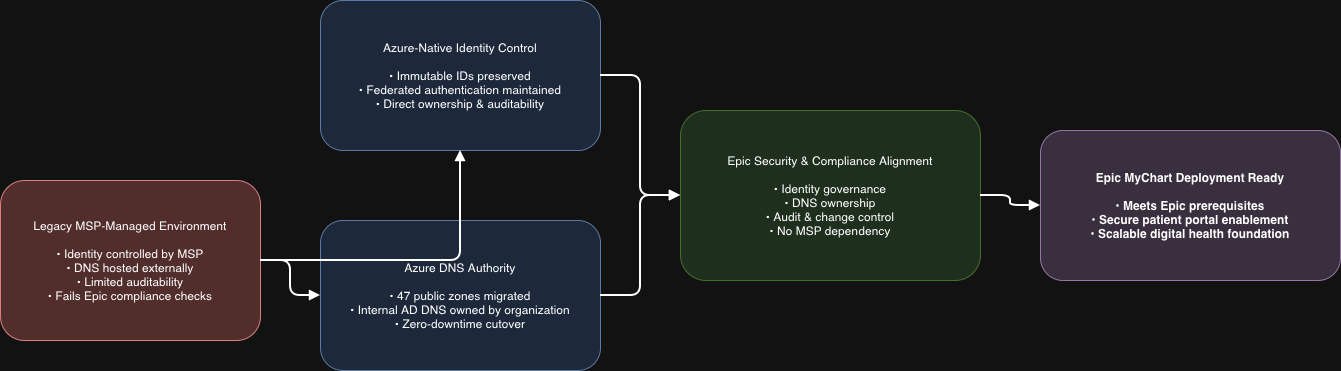
Before vs After: Architecture Transformation
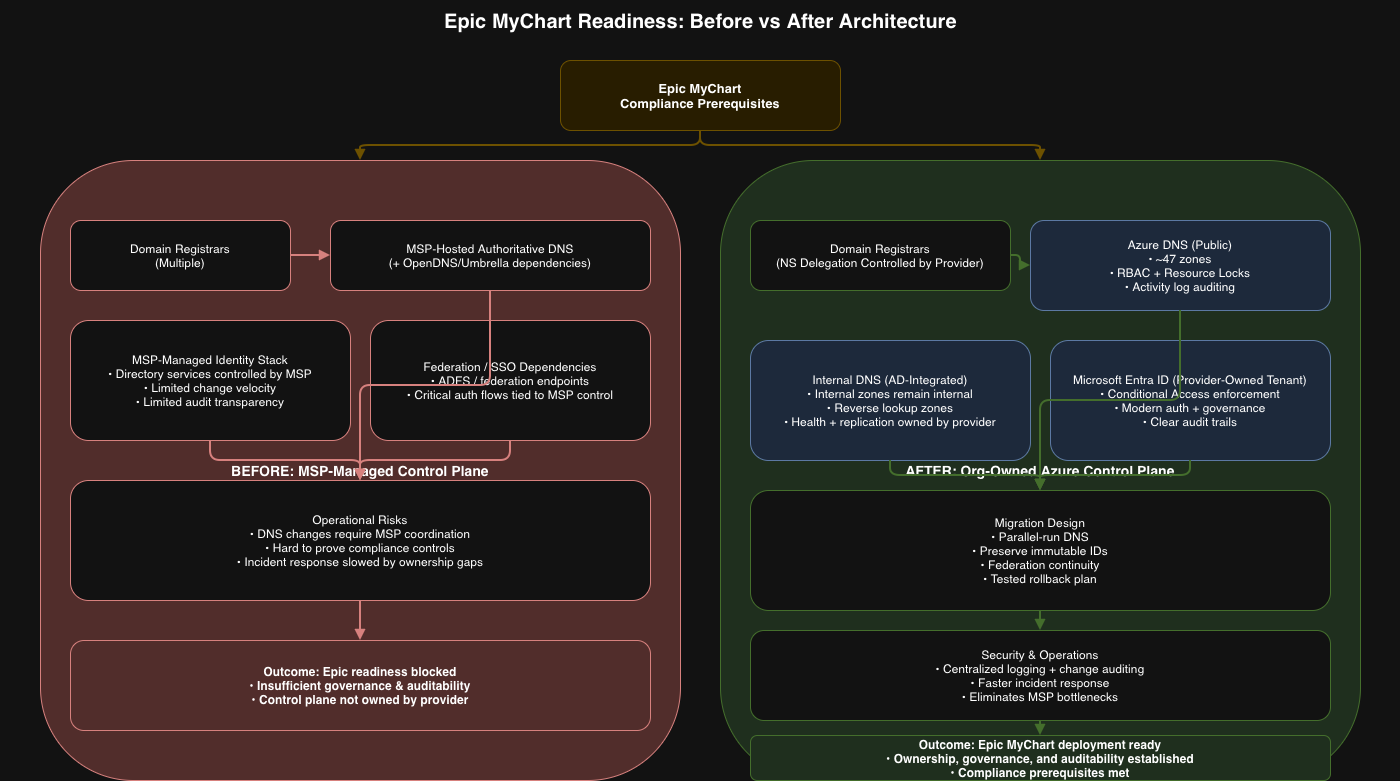
Before (MSP-Managed Control Plane)
- ✗Authoritative DNS hosted by an external MSP
- ✗Identity services controlled outside the organization
- ✗Federation and SSO dependencies tied to MSP-managed endpoints
- ✗Limited auditability and slow incident response
- ✗Epic readiness blocked due to governance gaps
After (Org-Owned Azure Control Plane)
- ✓Azure DNS as authoritative public DNS
- ✓Internal AD-integrated DNS fully owned and operated
- ✓Provider-owned Microsoft Entra ID tenant
- ✓Centralized logging, RBAC, and change auditing
- ✓Epic compliance prerequisites met
Solution Overview
The solution focused on reclaiming ownership of identity and DNS while maintaining uninterrupted clinical operations:
- Azure-native authoritative DNS for all public domains
- Internally owned AD-integrated DNS for private name resolution
- Azure-native identity with immutable identifiers preserved
- Migration from ADFS to Azure-native Single Sign-On
- Parallel-run migration model with tested rollback
- Zero downtime for users and applications
Identity and DNS were treated as foundational control-plane services, not isolated technical components.
Complete Enterprise Migration Architecture
End-to-end view of the Epic patient portal infrastructure and healthcare connectivity architecture
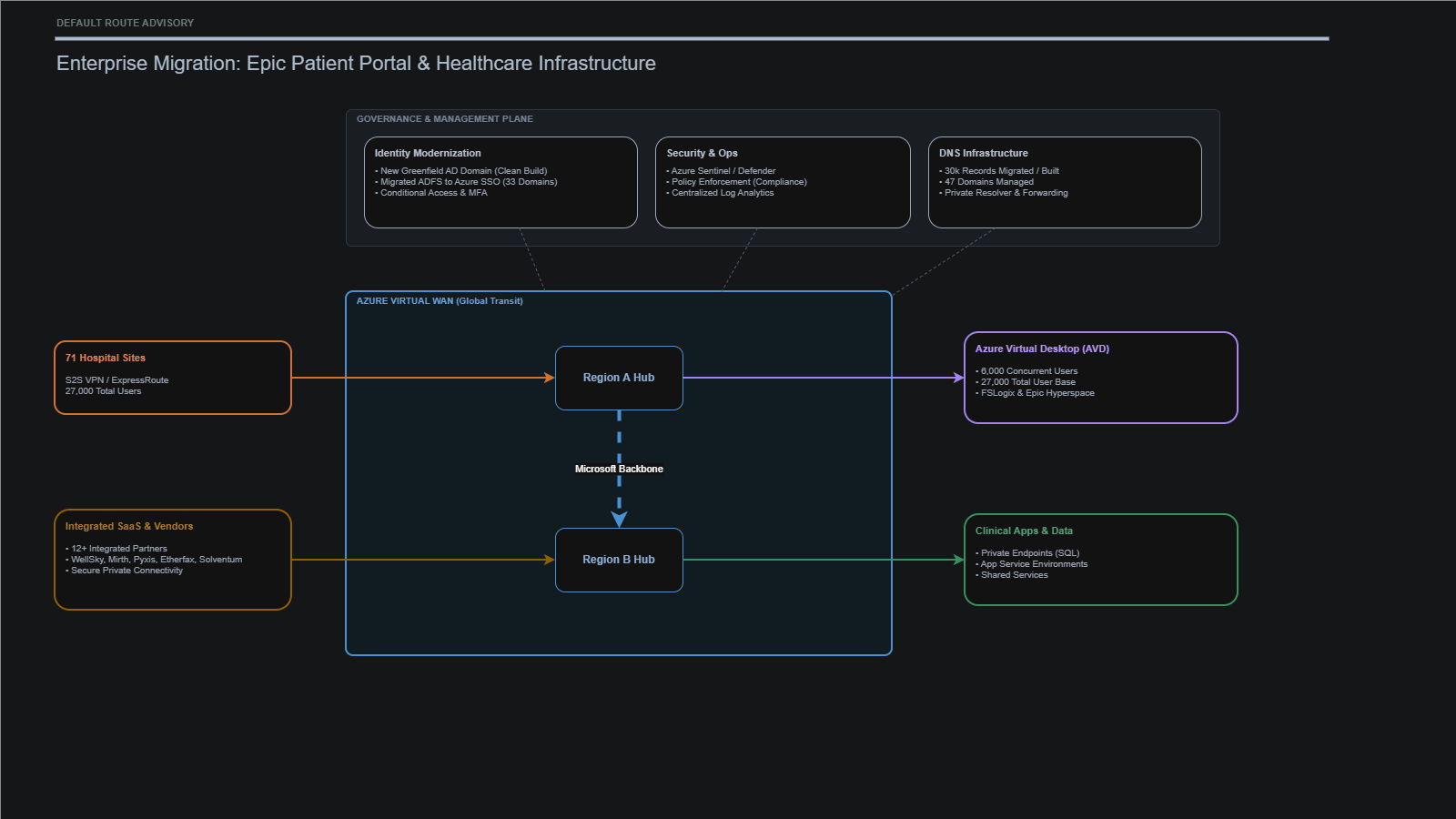
Enterprise Azure Architecture Context
This migration was executed within a large-scale, regulated Azure healthcare environment supporting mission-critical clinical operations.
The organization operates 71 hospital sites, interconnected through a multi-region Azure Virtual WAN (vWAN) architecture that provides resilient, segmented connectivity to internal systems and more than a dozen external healthcare and vendor platforms.
Key Platform Elements
- →Multi-region Azure vWAN serving as the primary connectivity backbone
- →Hub-and-spoke landing zone architecture, separating management, identity, and connectivity concerns
- →6,000+ concurrent Azure Virtual Desktop (AVD) sessions supporting clinicians and operational staff
- →Greenfield Active Directory domain build, replacing legacy MSP-managed directory services
- →Migration from ADFS to Azure-native Single Sign-On, simplifying authentication while strengthening security
- →Microsoft Defender and Intune integration, enabling endpoint protection, compliance enforcement, and centralized visibility
Within this environment, identity and DNS ownership were not incremental improvements—they were prerequisites for scale, security, and regulatory compliance.

Execution Approach
Discovery & Readiness
Comprehensive inventory of users, domains, DNS records, and federation dependencies.
Parallel Platform Build
Azure DNS and identity platforms built alongside existing MSP services.
Validation & Dry-Run Testing
Direct DNS queries, authentication validation, TTL reduction, and cutover rehearsals.
Zero-Downtime Cutover
Registrar delegation switched to Azure DNS without service interruption.
Post-Migration Verification
Monitoring, audit validation, and controlled MSP service decommissioning.
All phases were executed without disrupting clinical workflows or patient-facing systems.
Business Impact
Unblocked Epic MyChart deployment
Improved security posture and audit readiness
Reduced operational risk and MSP dependency
Increased change velocity and incident response speed
Established scalable Azure foundation for future digital health initiatives
Full internal ownership of identity and DNS platforms
Why This Matters
Healthcare platforms like Epic increasingly assume direct ownership of identity and infrastructure as a baseline requirement. Organizations that rely on externally controlled control planes face growing compliance risk, operational friction, and deployment delays.
This engagement demonstrates how reclaiming ownership of foundational services enables not only Epic MyChart, but long-term digital health transformation.
Technologies Used
Need to modernize your Azure architecture?
Let's discuss how we can help you establish compliant, scalable infrastructure.